
What Are Ectopic Parathyroid Glands?
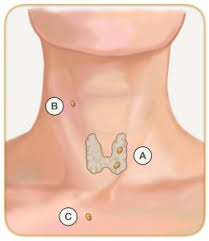
Parathyroid glands are exceptionally unique because they can function normally even in unusual locations. Regardless of their position, as long as they receive blood flow, they can monitor the calcium level in the bloodstream and respond to its fluctuations. Figure 1 illustrates some of the general locations where
parathyroids can be found. Most parathyroids are positioned in A, directly adjacent to the thyroid gland. A smaller percentage are located in B, below the thyroid gland, and potentially all the way down in the chest. Even rarer are parathyroids found in C, higher up in the neck, and even deep to the jaw and next to the throat.
How Parathyroids Develop & Get to Their Final Resting Position
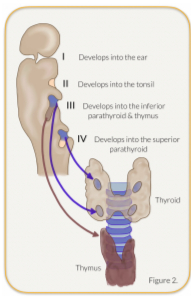
During the 6th week of life when we are in our mother’s belly the parathyroid glands develop as 2 pouches on each side of the throat and then travel down to rest behind the thyroid that is also traveling downwards into the lower neck. (Figure 2.) Because of
this migration and the fact that all the other
organs are also developing at the same time, sometimes the parathyroid glands end up in an unusual locations and not behind the thyroid. They may not travel far and stay up further in the neck or
overshoot and travel too far and end up in the chest.
Interestingly, the superior parathyroids develop in 4th pouch (the lower pouch) and travel less to end up in their final location. Because of a shorter migration
distance they end up having a more consistent location.
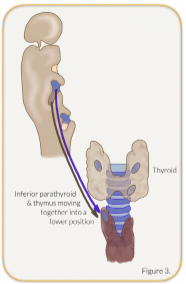
The inferior parathyroids travel a longer distance, so they can end up in an unusual position more often. The inferior parathyroid glands also develop in the same pouch as the thymus gland which travels along with the parathyroids and ends up finally in the upper middle chest. (Figure 3)
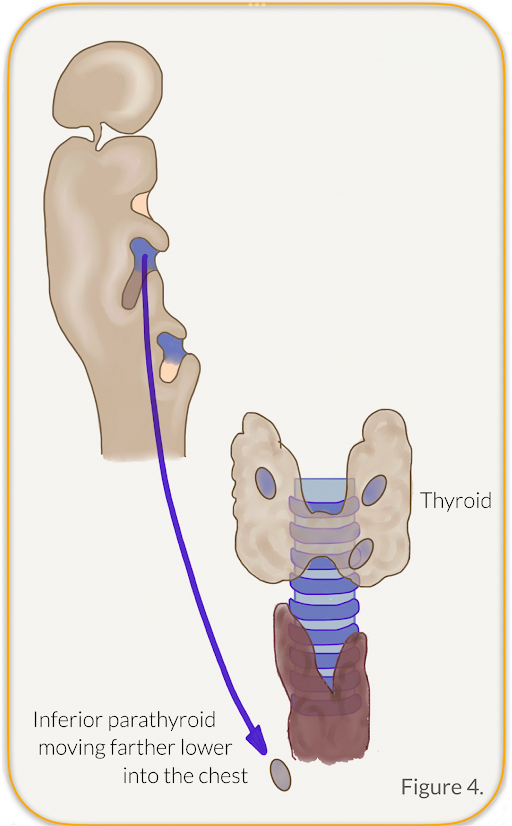
The inferior parathyroid glands develop from the third pharyngeal pouch and descend along with the thymus during embryonic development. So often times when a parathyroid gland cannot be found it maybe inside the thymus or even lower in the chest. (Figure 4)
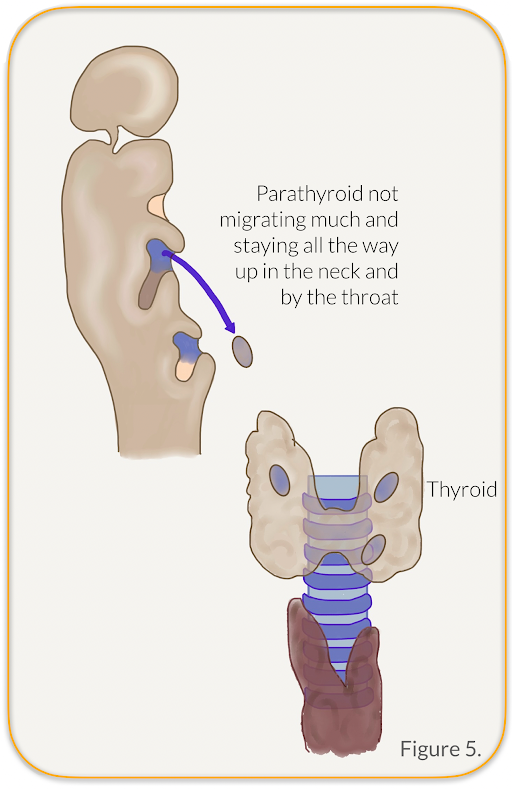
If either the superior or inferior parathyroid doesn’t travel much it may stay all the way up by the throat area where the pouch originally formed. Some parathyroid
glands can be found very high up in the neck and even deep to the jaw bone. (Figure 5)
Anatomy of The Neck & Parathyroid Glands
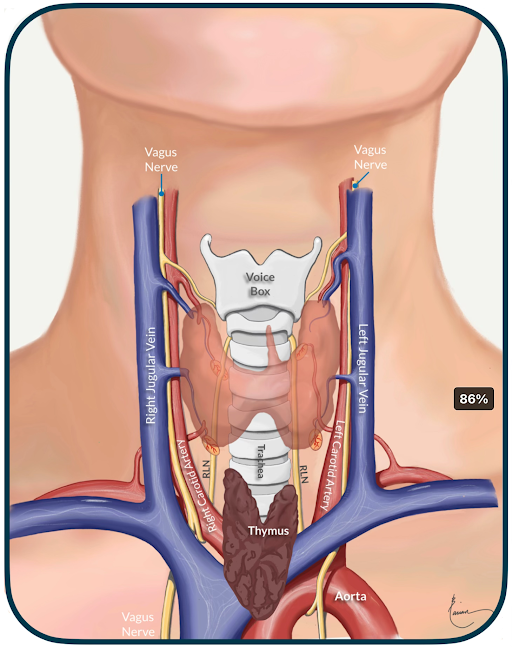
The nerve in charge of controlling the vocal cords is called the recurrent laryngeal nerve (RLN). There is one RLN on each side of the neck. The RLN generally travels under (or deep to) the inferior parathyroids and over
(or superficial to) the superior parathyroids. This is, in fact, the most certain way to know if the parathyroid you are removing is a superior one or inferior one, because the two parathyroids can be very close to each, or not in their usual location; their location with respect to the RLN can help the surgeon know which gland they are dealing with (superior or inferior).
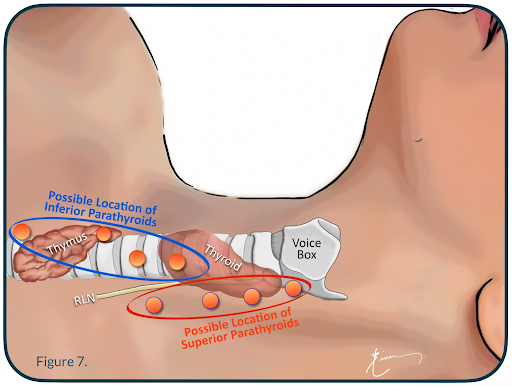
The position with respect to the RLN also helps the surgeon find an ectopic parathyroid gland. The inferior parathyroid glands are almost always superficial to the RLN, even when they are ectopic (blue area in Figure 7.). While the superior parathyroid glands are almost always deeper than the RLN, even when they are ectopic (orange area in Figure 7.).
Occasionally, the ectopic glands may be significantly higher or lower than these areas, making it challenging to locate them on scans or during surgery. Having a team of dedicated specialists reviewing the scans and developing a surgical plan is highly beneficial.
At the CENTER, we meticulously review the images ourselves to identify any ectopic glands that may have been overlooked by other physicians, surgeons, and radiologists. With increasing experience, we have discovered that we can detect glands that might have been missed by others, ultimately leading to more successful Parathyroidectomies.
The following are some of the extreme ectopic cases that we have treated.
Ectopic Case 1.
Right superior parathyroid in low position
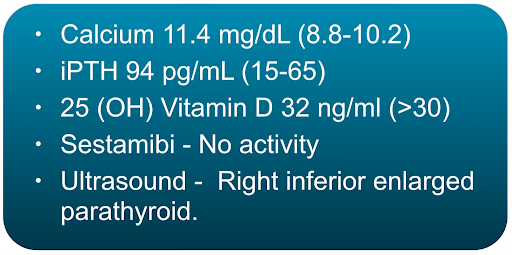
57 year old athletic woman who complains of fatigue, memory loss, poor sleep, increased anxiety, acid reflux, constipation, high blood pressure, palpitations, and frequent urination.The symptoms have been progressing for the past 3 years.
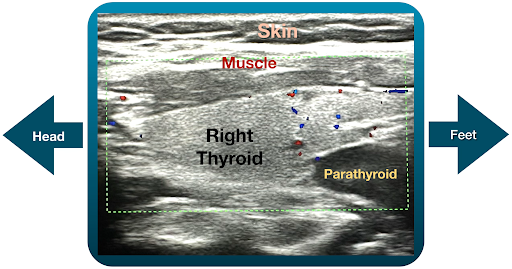
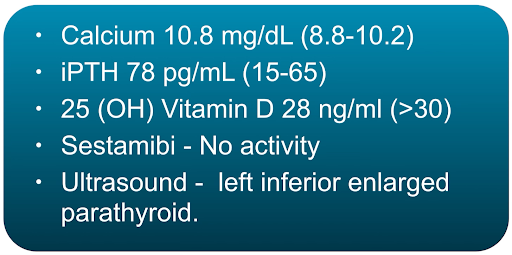
She had undergone a Sestamibi scan with another doctor that revealed activity in the right lower area. Upon her arrival at our CENTER, an ultrasound was conducted, which revealed an enlarged parathyroid gland situated just behind the lower part of the thyroid gland. Presumably, it’s the right inferior parathyroid gland, but considering the location, it could also be either the lower or upper (inferior or superior) parathyroid gland that has enlarged.
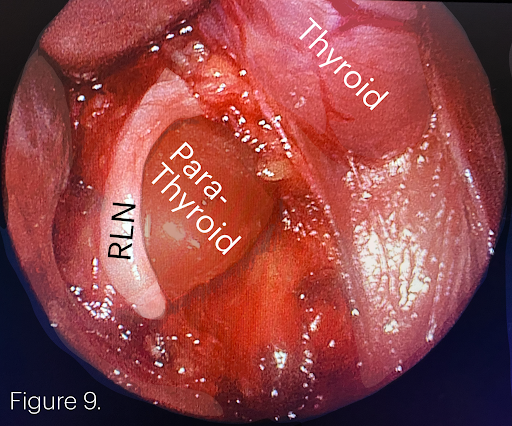
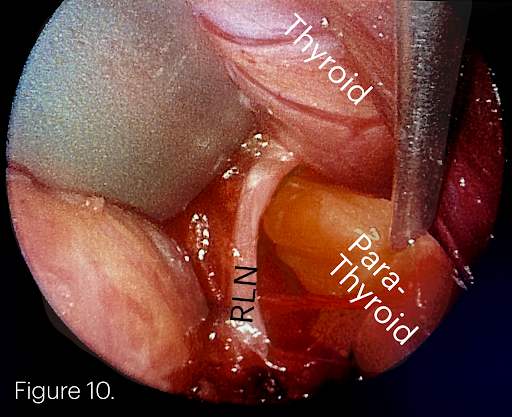
During surgery the right lower parathyroid was identified, but it appeared fatty and not enlarged; essentially it appeared normal. It was not removed and then the recurrent laryngeal nerve RLN or voice box nerve was identified just deep to this parathyroid gland. And just deep to the RLN was the enlarged right superior parathyroid gland which was at the same exact level as the inferior parathyroid gland (Figure 9). It was gently dissected from under the RLN (Figure 10), the blood vessels closed and the parathyroid adenoma was removed.
After removal PTH testing confirmed the success of the surgery and the appropriate functioning of the remaining 3 parathyroid glands. Long term follow up showed normalized calcium PTH and cure.
Ectopic Case 2.
Abnormal parathyorid glands in the upper chest.
46 year-old science teacher with symptomatic hyperparathyroidism (bone pain, brain fog ...) & osteopenia on boned density scan (DEXA).
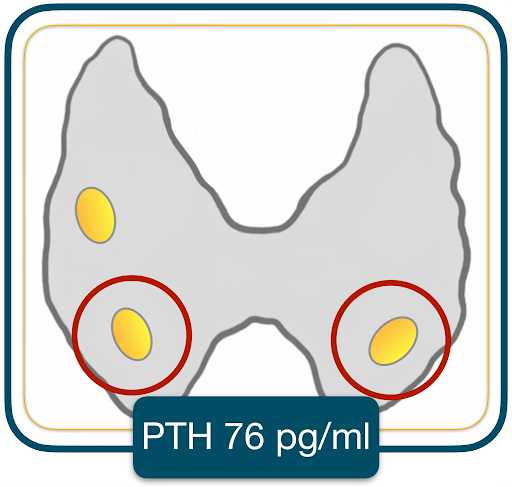
First surgery by an experienced surgeon: The surgeon reported both lower parathyroid glands were removed, the right upper was biopsied and the left upper was not found. PTH levels did not normalize during surgery and staid high at 76. He did not feel any different after surgery.
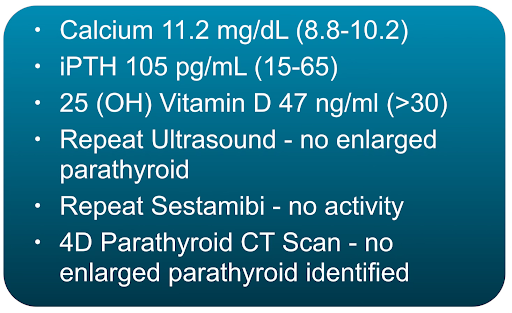
He was seen at the CENTER and underwent an extensive work up. Repeat ultrasound did not show any enlarged parathyroid glands. 4D Parathyroid CT scan was also negative. Repeat Sestamibi was also negative.
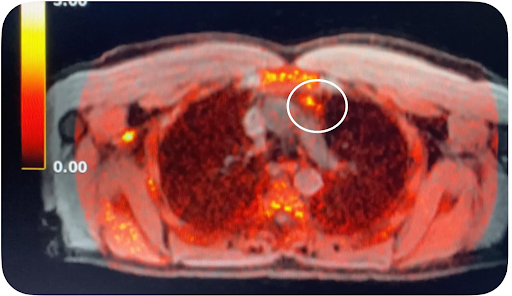
Since the abnormal parathyroid could not be found with conventional imaging studies, he underwent a PET-Choline Scan.
18F-FluorCholine PET/CT Scan showed two lesions in the left upper chest.
He underwent robotic minimally invasive chest surgery to remove the glands and Dr. Larian was present to make sure the PTH drop was appropriate and into the normal range, but also make sure the remaining right upper parathyroid that had been biopsied during the previous surgery was functioning adequately.
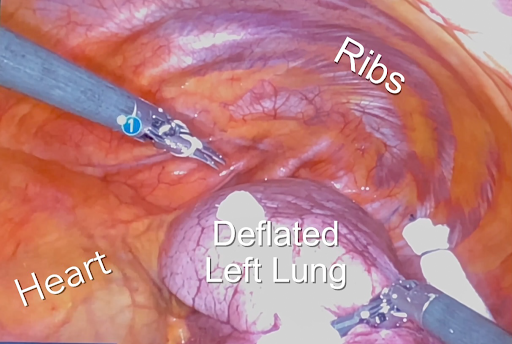
Robotic camera showing the inside of the left chest cavity after deflating the lung to be able to have more room to see and work.
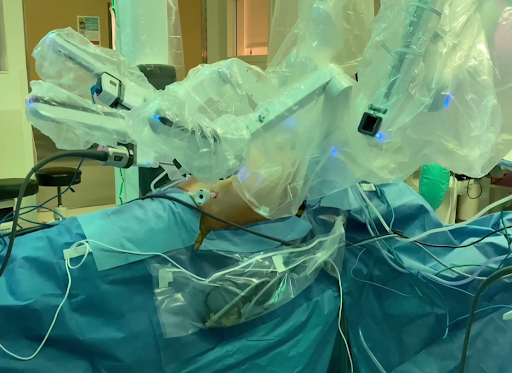
Robotic arms holding camera and instruments.
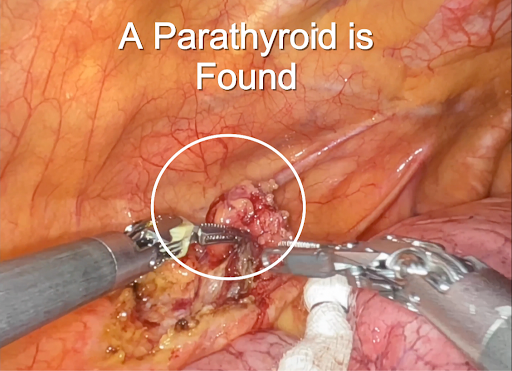
The first parathyroid has been found, and shortly the second parathyroid next to it will be identified to be removed.
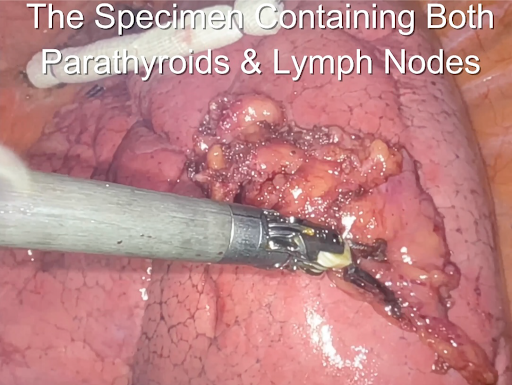
Both parathyroid glands along with a few adjacent lymph nodes are removed just in case there are smaller parathyroids in the vicinity. PTH level is then checked.
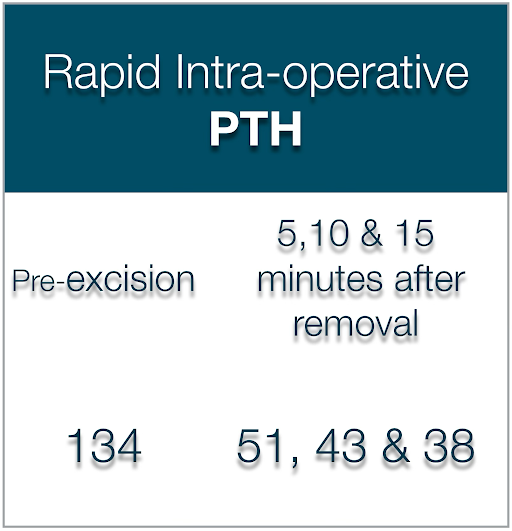
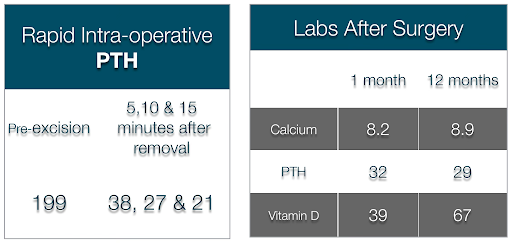
Rapid intra-operative PTH testing confirmed the surgery was successful and that the remaining right superior parathyroid is functioning adequately. Therefore, no parathyroid autotransplantation is needed. Pathology report showed two hypercellular parathyroid glands within the lower part of the thymus gland.
Follow up labs showed normalization of calcium and PTH. He felt dramatically better and continued to show improvement.
A bone density study (DEXA Scan) was done at 1.5 years after surgery which showed the osteoporosis had completed reversed and the bone density was in the normal range. He had been very active and hiking regularly which I’m certain helped speed up the bone recovery.
Ectopic Case 3.
Left upper parathyroid that had failed to migrate
down & was next to the upper throat.
42 year-old woman living in England. Who underwent her first parathyroid surgery which did not resolve her problem and caused left sided vocal cord paralysis.
After the first surgery, the labs continued to be similarly abnormal and she was suffering from a myriad of symptoms. A 4D parathyroid scan revealed a lesion in the left upper neck deep to the jawbone. A second surgery in England, revealed this to be a lymph node. This was followed by a third surgery some time later which again was unsuccessful.
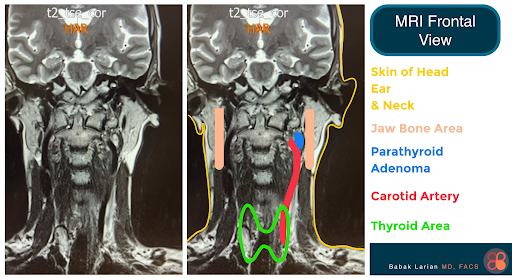
Being a strong minded, she refused to give in to her disease. She contacted us at the CENTER and we had her perform repeat scans. And on the repeat 4D parathyroid CT scan we could again see a lesion in the left upper neck deep to the jawbone. Dr. Larian compared it to the previous 4D parathyroid CT scan and found the lesion had not been removed. He ordered MRI scans to look the anatomy of this region in detail and discovered the lesion was not part of the salivary gland (parotid gland) that was just next to it.
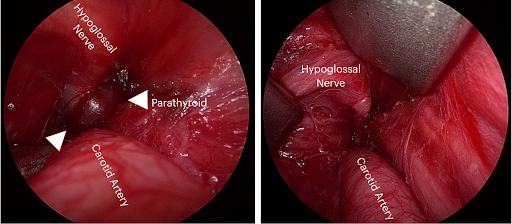
She was taken to the operating room and underwent a parapharyngeal space parathyroid adenoma removal, with rapid intra-operative PTH testing. This was done through a 3cm incision below the jawbone.
Parathyroid found between the carotid artery & the hypoglossal nerve. Just next to the throat.
Parathyroid easily removed. The carotid artery & the hypoglossal nerve are visible after parathyroidectomy.
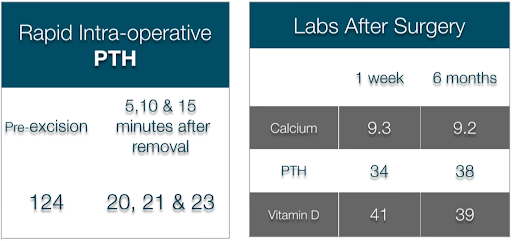
PTH levels dropped into the normal range writing 5 minutes and staid in the low normal range during surgery, indicating the remaining glands were not overworking and functioning adequately. Therefore no auto transplantation of the removed parathyroid gland was needed. She started to feel improvement of symptoms immediately.
Why Do Patients Choose The CENTER & Dr. Larian for Parathyroidectomy Surgery?
Localization studies and intra-operative PTH testing are crucial parts of hyperparathyroidism surgery, especially in ectopic parathyroid cases. Yet, these assessments are sometimes ignored as part of the parathyroidectomy treatment process. And in some instances, HPT patients suffer the consequences.
For example, if multiple abnormal parathyroid glands are present but go undetected prior to a parathyroidectomy, a patient is unlikely to know about these diseased glands. As a result, if PTH testing is not completed, a patient may continue to cope with HPT symptoms, even after a parathyroidectomy surgery is completed.
By partnering with Dr. Larian, patients receive personalized support to treat HPT symptoms. First, Dr. Larian helps the patients come to the correct diagnosis, and then conducts the appropriate localization studies to identify any abnormal parathyroid glands. Dr. Larian then offers a custom treatment plan to address diseased parathyroid glands, which may include parathyroidectomy surgery.
Before Dr. Larian performs parathyroid gland surgery, his patient is prepared for treatment. Dr. Larian teaches his patient about parathyroidectomy surgery and responds to any concerns or questions. Furthermore, Dr. Larian provides postparathyroidectomy information, so his patient can fully recover from surgery, as quickly as possible.
On the day of a parathyroid gland procedure, Dr. Larian performs rapid intraoperative PTH testing. He ensures that all abnormal parathyroid glands are removed, as well as tracks a patient's progress following treatment. With this approach, Dr. Larian has become a leader in parathyroid gland surgery.
Talk to a Parathyroid Expert Today!
Dr. Larian offers insights into parathyroidectomy surgery and PTH testing and is happy to discuss parathyroid gland surgery. Also, Dr. Larian can help patients determine if parathyroid gland surgery is the best choice for treatment, along with performing an MIP that helps his patient alleviate HPT symptoms and prevent them from recurring.
If you would like to know more about the benefits of intraoperative PTH testing, or if you are considering an MIP, schedule a consultation with our parathyroid expert, Dr. Larian, by calling 310.461.0300 today!
Parathyroid Disease
If there is a disturbance in just a single cell on one of the parathyroid glands and the calcium levels are no longer being monitored properly, you will develop hyperparathyroidism. Watch the video below to learn about hyperparathyroid disease.
Ectopic Gland FAQ
- If a person has 3 parathyroid glands, or 5, is the functioning of the parathyroid system any different?
No, unfortunately the blood tests do not and cannot distinguish between these situations.
- Does the location of the parathyroid gland effect how it functions?
No. As long as there is blood vessels feeding the parathyroid and connected to it, the parathyroid can function properly.
- If a person has only 3 parathyroids and one of them is abnormal (parathyroid adenoma) and removed, will having only 2 parathyroids be adequate to maintain calcium balance?
Yes, we only need one gland to function properly to be able to maintain calcium balance.
- How does the surgeon know where the abnormal parathyroid is, if the scans don’t show it?
Experts surgeons that are familiar with parathyroid growth and migration path, know the likely areas where the misplaced parathyroids may be, and focus their attention during surgery to those areas.
- If a person has more then 4 parathyroids and hyperparathyroidism caused by parathyroid hyperplasia with all the glands being abnormal, how would the surgery be done?