
Parathyroid Gland Function & Development
Unless you have parathyroid disease or know someone who has it, chances are that you have never heard of the parathyroid glands. The four parathyroid glands located near the thyroid gland in the neck—typically two on each side—and they are part of the endocrine hormonal system. The thyroid gland and the parathyroid glands are not related in terms of what they do; they are just next to each other.
The prefix ‘para’ means next to; since the parathyroid glands were discovered long after the thyroid and their function was not clear at the time, they were simply named the parathyroid glands based on their location, but they do not have the same function or purpose as the thyroid gland.
Although they do not have the same function, they do develop in humans at the same time as the thyroid gland and share the same blood vessels. The major branches of the thyroid arteries and veins go to the the thyroid gland and the very small branches go to the parathyroid glands.
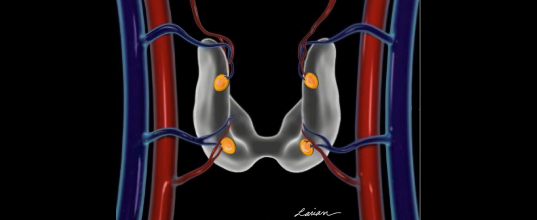
Parathyroid Glands Regulate Calcium
We have four parathyroid glands (when one would be enough to do the job) because maintaining precise calcium levels is so important to our body’s ability to function properly on a daily basis. To regulate calcium, the parathyroid gland controls the amount of a chemical called parathyroid hormone (PTH) that it releases into the bloodstream. Each parathyroid cell has a calcium sensor to detect the level of calcium in the blood. When calcium levels are high, the parathyroid gland “turns off,” and the body’s PTH level decreases. Alternatively, when the calcium sensor detects that calcium levels are low, the gland “turns on” and produces PTH, which pours into the bloodstream and instructs the body to put more calcium back into the blood.
The parathyroid glands measure the amount of calcium in the blood every minute of every day, and if the calcium levels are lower than the parathyroid gland wants, the glands will recognize it right away and make PTH. Next, PTH goes to other parts of the body mainly the bones and kidneys, and instructs them to increase the calcium in the blood. When the calcium level comes up again, the parathyroid gland shuts down and stops making PTH. Through this feedback loop, the body is able to have precise control over the level of calcium in the blood.
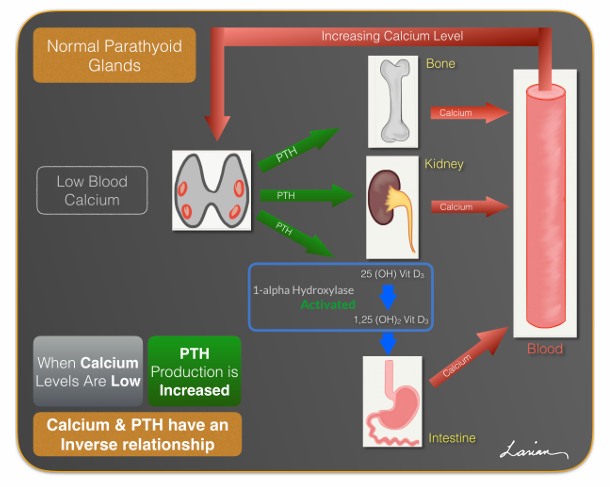
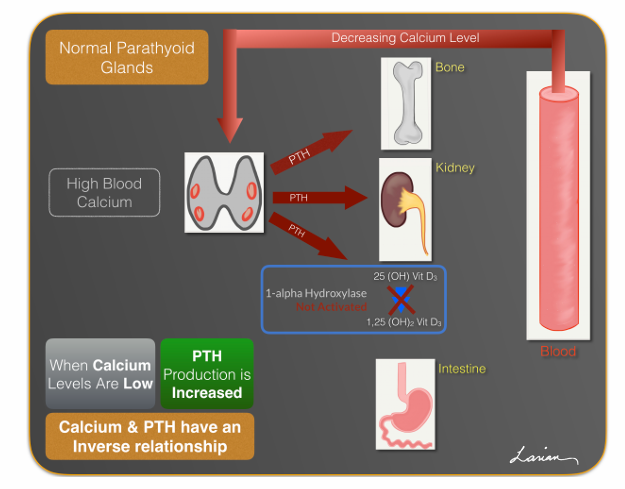
Dr. Gordon Strewler published an interesting article in 2005 that showed the relationship between calcium and PTH. He showed that there is an inverse relationship between calcium and PTH, with PTH being low when calcium is high, and PTH high when calcium is low. The first graph below shows his results. Dr. Strewler found that when the calcium level changes only a minimal amount, the parathyroid gland responds immediately to bring the calcium back to the person’s normal (called the calcium set point). The calcium set point functions similarly to a thermostat; when you set the temperature to 70°F, the heater will work when the temperature in the house goes down to 67°F, and stop working when it goes above 70°F.
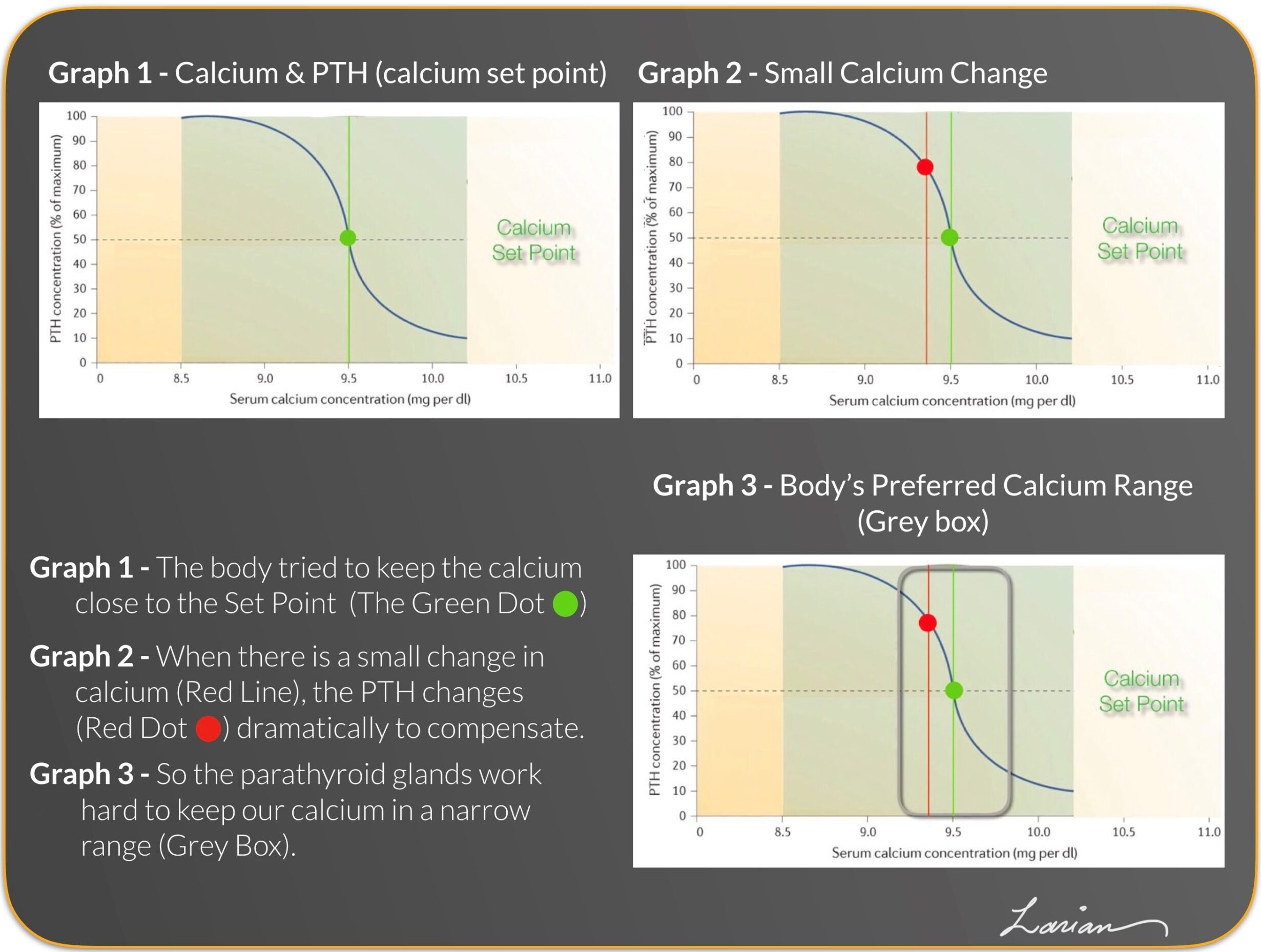
Each individual’s Calcium Set Point is different from others. Some may be in the lower ranges of the reference values (what laboratories call a normal range) for example 8.8mg/dL, some in the middle (9.5mg/dL), and some in the higher (10.0mg/dL). As these graphs show clearly, it does not matter what the set point value for each person is, their parathyroid gland is in charge of making sure the calcium level is always either maintained at that level or brought back to that level.
The parathyroid glands are very good at keeping the calcium at the calcium set point or close to it. If the set point is 9.5 mg/dL as in the graphs above, then the parathyroids will work tirelessly 24 hours a day to keep the calcium close to that, and if there are slight changes the parathyroid glands react immediately to bring the level back to the set point. The body is able tolerate much higher or much lower calciums for short periods of time, but when it occurs for an extended period then all organs begin to become inefficient and malfunction. So the range of normal that the parathyroid will allow is actually a very a narrow range as seen on Graph 3 above; the set point is 9.5 mg/dl, but the range is the area in the grey box from 9.2-9.8 mg/dl. Calcium may occasionally go out of that range but as you can see based on the graph the PTH reaction is dramatic to bring the calcium back into range. The laboratory normal range (also known as the reference range) is shown in the graph as the green shade (8.5-10.2 mg/dl) in between the yellow shaded areas at the two ends of the graph.
Parathyroid Hormone (PTH) & PTH Receptor
The hormone PTH is very interesting in and of itself. It is a 3 dimensional protein that has parts of it that attach to other proteins called receptors on the surface of other cells in a lock and key fashion. This is how it gives its instructions to other tissues like bone and kidney. It is a command, so it has been designed to disintegrate shortly after it has been released in the blood stream. Half of the PTH proteins disintegrate within 5 minutes of going into the bloodstream. This is so that if the parathyroids want to give a different command a few minutes later the hormone is not hanging around in the blood to interfere with the new command.
The rapid intra-operative PTH test done during surgery takes advantage of this short lifespan (also called a half-life). The parathyroid receptor is present on many different areas of the body including kidneys, bone, adrenal glands, cartilage, heart muscle, nerve cells in various parts of the brain. So when a person has hyperparathyroidism some of the symptoms are due to high calcium in the blood, and others are directly from the PTH. In fact, some of the symptoms directly correlate with the level PTH in the blood.
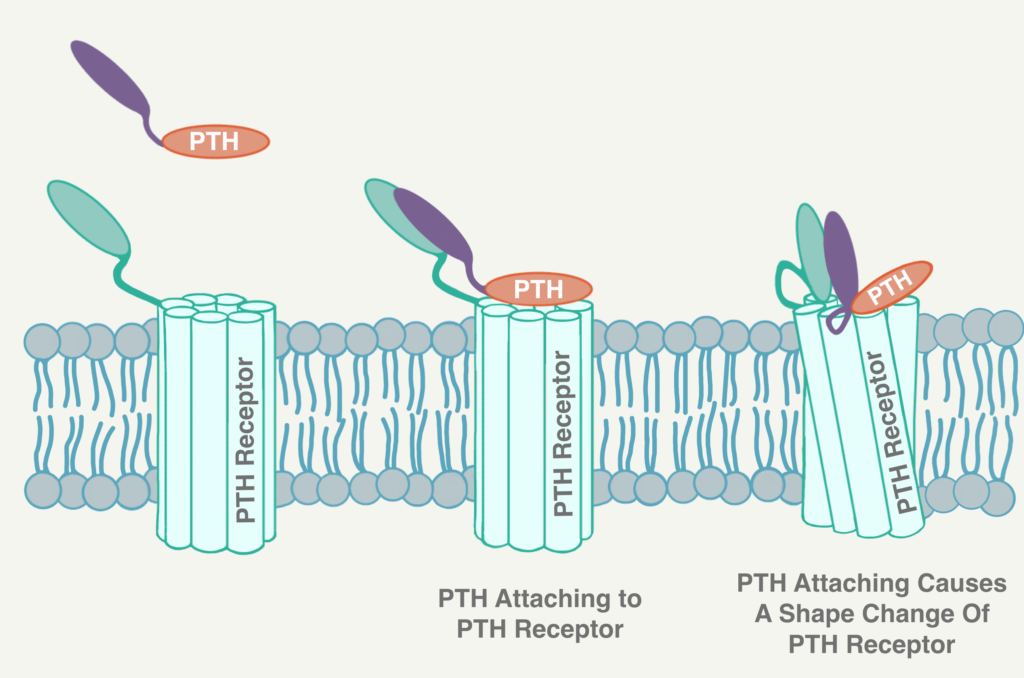
Calcium and PTH on a Cellular Level
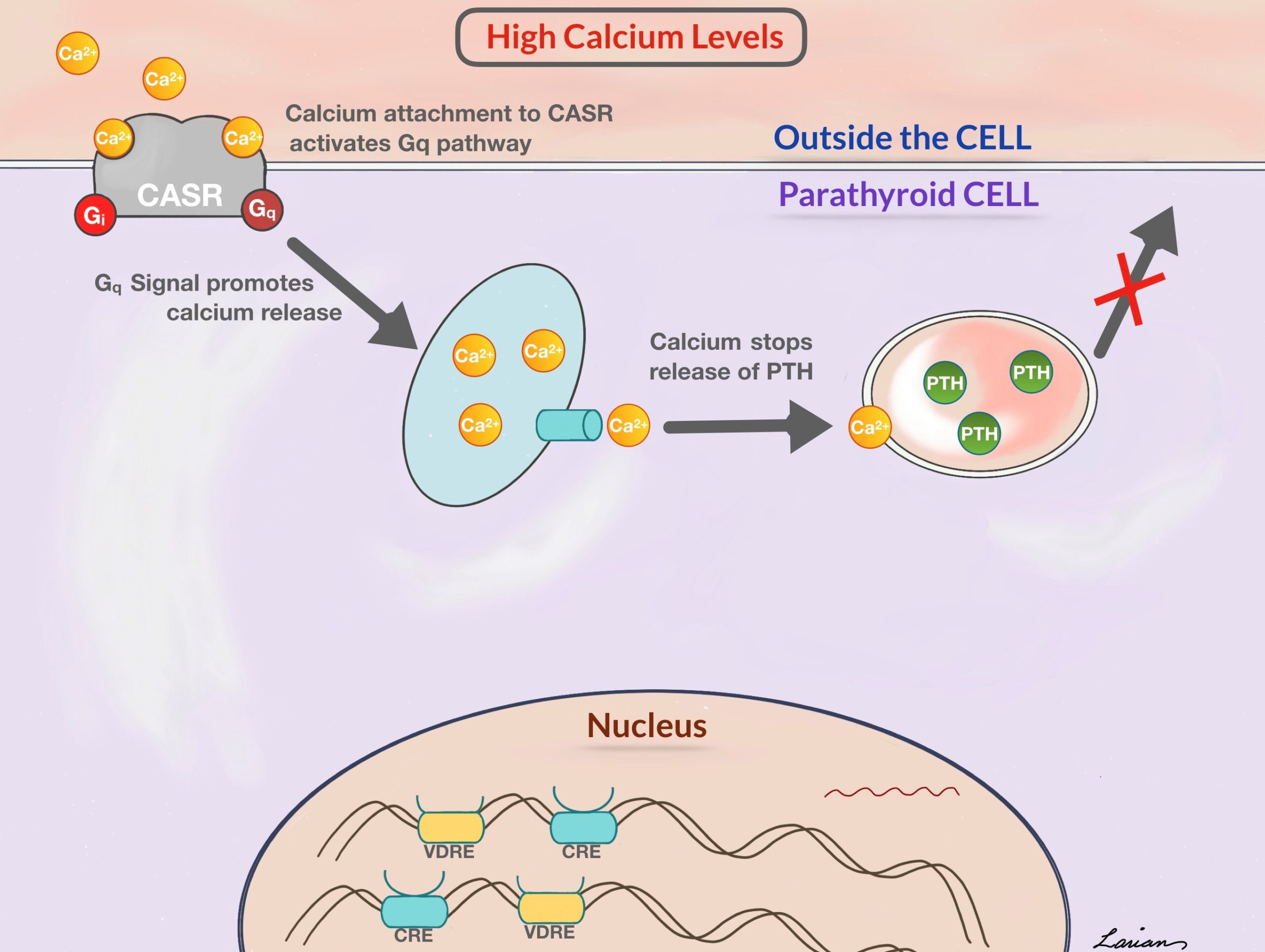
When calcium levels are high in the blood, they seep out of the blood vessels into the fluid surrounding cells. The calcium elements will then attach to the Calcium Sensing Receptor (CASR) on the surface of parathyroid cells, and start a series of reactions that ultimately result in stopping the release of PTH from the cell. In doing this the level PTH in the blood stream comes down because whatever PTH was already in the blood will quickly disintegrates and disappears.
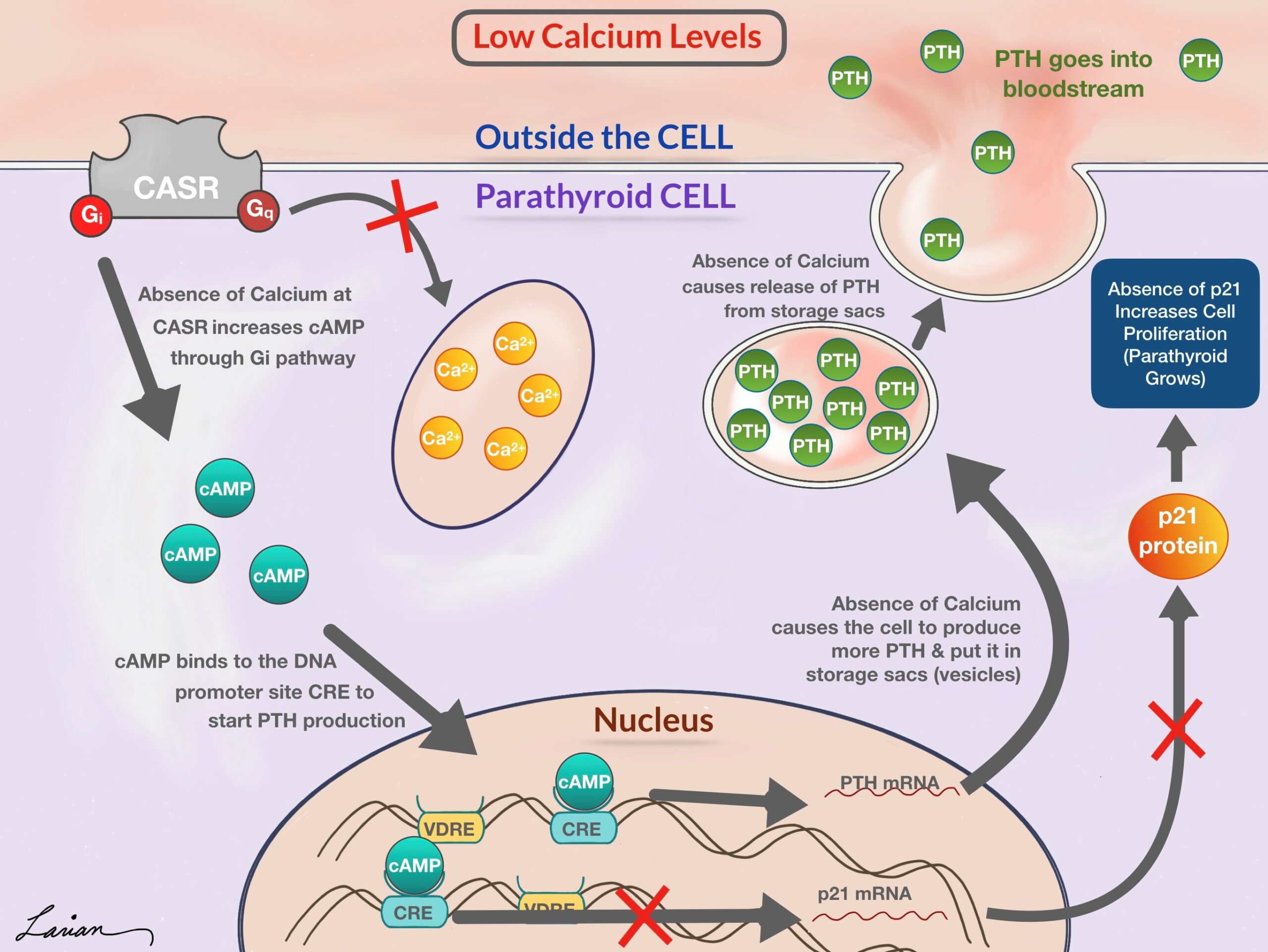
On the other hand, when calcium levels are low, and no calcium is attached to the CASR, another set of reactions occur that ultimately increase the PTH release outside of the cell and into the bloodstream. When low calcium levels happen for a short period of time, then the parathyroid cell will signal the sacs (vesicles) containing PTH to merge with the surface and release what is inside the sac (PTH). When the low calcium level goes on for an extended period of time, in addition to releasing the PTH containing sacs, the parathyroid glands send signals to the nucleus (brain of the cell) to start the process of manufacturing PTH and place it in the storage sacs. If the calcium level stays chronically low, then, through a different series of reactions (P21 protein), parathyroid cells are signaled to duplicate themselves (proliferate). Thus, the parathyroid gland may grow to keep up with the demands of the body.
Parathyroid Disease
If there is a disturbance in just a single cell on one of the parathyroid glands and the calcium levels are no longer being monitored properly, you will develop hyperparathyroidism. Watch the video below to learn about hyperparathyroid disease.
Parathyroid Gland FAQ
To start a large portion of healthy population (more then 60%) has vitamin D deficiency so when we say “normal” PTH level ranges between 15-65, it does include these patients. A higher proportion of patients with PHPT have vitamin D deficiency. Because vitamin D causes the parathyroid glands work less and causes lowering of PTH, if there is vitamin D deficiency then the range of PTH should be different as shown in the article below. It should be less by 25%, so the upper limit of normal for PTH in a person who has vitamin D levels higher then 30 ng/ml should be 48 pg/ml rather then 65 pg/m.

Parathyroid Gland Surgery
Choose the Right Surgeon to Perform a Parathyroid Gland Procedure
Dr. Larian is available to meet with an individual to assess his or her parathyroid gland function and offer a personalized treatment recommendation. To schedule a consultation with Dr. Larian, please call us today at 310-461-0300.
Sources:
- https://www.hopkinsmedicine.org/health/conditions-and-diseases/the-parathyroid-glands
- https://www.empoweryourhealth.org/parathyroid-gland
- http://endocrinediseases.org/parathyroid/faq.shtml
- http://endocrinediseases.org/parathyroid/faq.shtml#q3
- https://www.livescience.com/58980-parathyroid-glands.html
- https://www.saintjohnscancer.org/endocrine/conditions/hyperparathyroidism/